Carbon fibre tubes have become one of the most important materials in modern engineering because they combine very low weight with very high strength and stiffness. They are used in industries such as aerospace, automotive engineering, robotics, marine structures, sporting equipment, drones, surveying tools, and industrial machinery. Even though they may look similar from the outside, not all carbon fibre tubes perform the same way. The way they are manufactured, how the fibres are arranged, and the type of resin system used all have a major impact on how the tube behaves under different types of load.
Choosing the right Carbon Fiber Water Fed Pole is not only about strength. It is about understanding how the tube will be used in real conditions. A tube that performs extremely well in one direction may perform poorly in another. That is why engineers look at tensile strength, compressive strength, torsional stiffness, bending resistance, weight efficiency, and durability before selecting a specific type.
At the core of carbon fibre tube selection are two main manufacturing styles: pultruded tubes and roll-wrapped tubes. These two types form the foundation of most carbon fibre tube applications, and each has very different structural characteristics.
Pultruded carbon fibre tubes are made using a continuous process where carbon fibres are pulled through a resin bath and then guided through a heated die. This process aligns all fibres in a single direction along the length of the tube. Because of this alignment, pultruded tubes offer extremely high strength and stiffness along their length. When a load is applied straight along the tube, the fibres carry the load very efficiently. This makes pultruded tubes one of the strongest options available for axial loading.
However, this same fibre alignment also creates a limitation. Since almost all fibres run in one direction, pultruded tubes are not as strong when forces are applied sideways or when the tube is twisted. They can be more vulnerable to splitting, crushing, or delamination under complex loads. In simple terms, they are extremely strong in a straight line but weaker when forces come from multiple directions.
Roll-wrapped carbon fibre tubes are made in a very different way. Instead of pulling fibres in one direction, layers of carbon fibre sheets are wrapped around a mandrel at different angles and then cured under heat and pressure. These layers often include both longitudinal fibres and hoop fibres, meaning fibres run along the length of the tube as well as around its circumference. This multi-directional structure gives roll-wrapped tubes a more balanced mechanical performance.
Because of the hoop layers, roll-wrapped tubes have much better resistance to crushing and twisting. They can handle torsional loads more effectively and are generally more durable in real-world conditions where forces are not perfectly aligned. Although they may not always match pultruded tubes in pure axial stiffness, they often outperform them in overall structural reliability.
Other manufacturing methods also exist, but they are more specialized. Filament winding, for example, is commonly used for pressure vessels and cylindrical tanks. In this method, fibres are wound at controlled angles to optimize hoop strength and internal pressure resistance. There are also hybrid methods where fibres are combined with other materials like glass fibre or aramid to improve specific performance characteristics.
To understand how these tubes perform in practice, engineers use mechanical testing. These tests help compare carbon fibre tubes with traditional materials like stainless steel and aluminium under identical conditions. A common approach is to test tubes with the same dimensions, such as 10 mm outer diameter and 8 mm inner diameter, to ensure a fair comparison.
One of the most important tests is the tensile strength test. In this test, the tube is pulled from both ends until it breaks. This test shows how much force the tube can handle when stretched. Carbon fibre generally performs extremely well in this test when the load is applied along the fibre direction. In ideal conditions, pultruded carbon fibre tubes can outperform steel several times over in tensile strength while being significantly lighter. Aluminium performs much lower in comparison due to its lower strength and stiffness.
However, real-world testing often shows a limitation in how carbon fibre behaves during tensile testing. Failure can occur at the gripping points if the load is not distributed properly. This does not always reflect the true material strength but highlights the importance of proper design and clamping methods in testing.
Compression testing is another important method used to evaluate performance. In this test, force is applied to compress the tube from both ends. Stainless steel generally performs very well in compression because of its ductile nature and uniform structure. Carbon fibre tubes also perform well but can fail suddenly if stress is concentrated in one area. Aluminium tends to fail earlier due to its lower compressive strength. Between the two carbon fibre types, pultruded and roll-wrapped tubes often show similar compressive strength, although their failure behaviour differs slightly due to fibre orientation.
Torsional stiffness testing evaluates how well a tube resists twisting forces. This is one area where carbon fibre does not always outperform metals. Steel generally performs best in torsion because it has uniform properties in all directions. Aluminium also performs reasonably well. Pultruded carbon fibre tubes are weaker in torsion because their fibres are aligned only along the length of the tube. Roll-wrapped tubes perform better because they include angled fibres that help resist twisting forces. Even so, both carbon fibre types may show more deformation under torsion compared to steel.
The three-point bending test is one of the most important tests for real-world applications. In this test, the tube is supported at two points while force is applied in the center. This simulates bending loads that are common in many structural applications. In this type of test, roll-wrapped carbon fibre tubes often perform better than pultruded ones because their layered structure resists crushing and cracking more effectively.
Steel also performs strongly in bending due to its ductility, but it is much heavier. Aluminium generally performs the weakest because it bends and deforms more easily under load. When weight is considered, carbon fibre becomes significantly more efficient. Even if steel and carbon fibre show similar performance in some absolute tests, carbon fibre delivers far better strength-to-weight efficiency because it is much lighter.
Density plays a major role in performance comparison. Steel is roughly five to six times heavier than carbon fibre, while aluminium is about two times heavier. This means that even if raw strength numbers look similar, carbon fibre provides a much better performance per unit weight. This is the main reason it is widely used in aerospace, motorsport, and high-performance engineering applications.
When selecting between pultruded and roll-wrapped tubes, the application requirements become the deciding factor. Pultruded tubes are best suited for applications where loads are predictable and act mainly in one direction. They are commonly used in arrow shafts, UAV structures, robotics arms, kite frames, lightweight rods, and structural supports where axial strength is critical.
Roll-wrapped tubes are better suited for applications where loads are complex and come from multiple directions. They are commonly used in bicycle frames, drone arms, camera equipment, marine structures, lightweight aircraft components, and industrial tools. Their ability to resist twisting and crushing makes them more suitable for real-world conditions where forces are not controlled or predictable.
Roll-wrapped tubes with a woven outer layer also offer improved cosmetic appearance and better resistance to surface cracking. This makes them ideal for visible applications where both performance and appearance matter. The woven structure also helps slow crack propagation, which improves long-term durability.
Despite their advantages, carbon fibre tubes are not perfect for every application. One major limitation is temperature resistance. Most carbon fibre epoxy systems begin to lose strength at temperatures above around 120 degrees Celsius. This makes them unsuitable for high-heat environments such as engines or exhaust systems.
Another limitation is wear resistance. Carbon fibre surfaces do not handle continuous abrasion well. If used in applications involving sliding contact, the surface can wear down quickly. This makes them unsuitable for bearings or moving contact surfaces unless additional protective layers are used.
Machining carbon fibre also requires special care. Unlike metals, carbon fibre cannot be threaded directly in most cases because it may split or weaken. Instead, metal inserts or reinforced fittings are used for joining and fastening. Cutting and drilling must also be done carefully to avoid fibre damage or delamination.
Joining carbon fibre tubes is another design challenge. They cannot be welded like metals. Instead, engineers rely on adhesives, mechanical couplers, or composite reinforcements. These joints must be carefully designed because they often become the weakest points in the structure if not properly engineered. Get more info about Carbon Fiber Jet Surfboard.
Another limitation is that carbon fibre cannot be reshaped after production. Metal tubes can be bent or formed into new shapes, but carbon fibre must be manufactured in its final form. This means design planning is extremely important before production begins.
In real-world engineering, selecting the best carbon fibre tube is always a balance between strength, weight, stiffness, durability, and cost. There is no single “best” tube for every application. Instead, the right choice depends entirely on how the tube will be loaded and used.
Pultruded tubes offer maximum axial performance and are ideal for simple load paths. Roll-wrapped tubes offer more balanced strength and better resistance to complex forces. When compared to steel and aluminium, both carbons fibre types provide superior weight efficiency, even if absolute strength may vary depending on the test.
Here is some Carbon Fiber Water Fed Pole available online:
A carbon composite water fed pole BWFG4 is a versatile cleaning tool designed for reaching high surfaces such as windows, glass facades, and solar panels while keeping the user safely on the ground. It is built using a combination of carbon fiber and fiberglass, creating a hybrid structure that balances strength, weight, and cost. This makes it a popular choice for both homeowners and professionals who need reliable performance without investing in fully carbon fiber equipment.
The carbon composite construction provides a noticeable advantage in handling and usability. It is lighter than traditional fiberglass poles, which reduces strain during extended use, yet it remains strong enough to maintain stability at moderate heights. The added carbon fiber improves stiffness, allowing better control when the pole is fully extended. This helps users clean more efficiently, especially when working on upper floors or hard to reach areas.
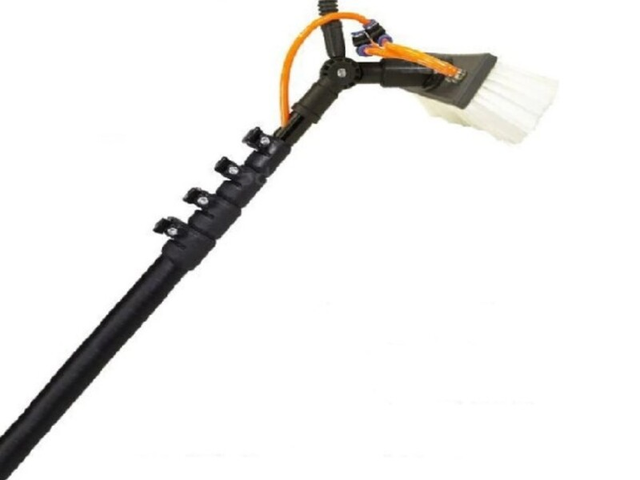
The telescopic design is another important feature that enhances convenience. The pole can be extended to the required height and then collapsed into a compact size for easy storage and transport. Each section is typically secured with clamp mechanisms that keep the pole stable during use. At the top, a brush head can be attached, and water is delivered through an integrated hose system. This allows continuous water flow directly to the brush, making it possible to wash and rinse surfaces at the same time without using harsh chemicals.
In terms of application, the BWFG4 model is well suited for medium height cleaning tasks such as residential buildings, small commercial properties, and maintenance of solar panels. It offers a good balance between performance and affordability, making it ideal for regular use.
Durability is also a strong point, as the composite material resists corrosion and can withstand exposure to water, sunlight, and changing weather conditions. A carbon composite water fed pole BWFG4 provides a dependable and efficient solution for high reach cleaning with improved comfort and control.
A carbon composite water fed pole BWFG10 is a professional grade cleaning tool designed for high reach window cleaning, solar panel washing, and exterior maintenance tasks where safety and efficiency are important. It is part of the BWFG series, which uses a hybrid construction combining carbon fiber and fiberglass materials to deliver a balance of strength, rigidity, and affordability. This makes it suitable for both residential and commercial users who need a reliable extended reach solution without the full cost of ultra high modulus carbon fiber systems.
The BWFG10 model is typically designed for taller working heights compared to smaller versions in the same range, offering improved reach and stability for multi story buildings. The carbon composite structure helps reduce overall weight while maintaining enough stiffness to control the pole even when fully extended. This is especially important when working at height, as reduced flex improves accuracy and reduces physical strain during long cleaning sessions.
One of the key features of this pole is its telescopic design, which allows the user to extend it section by section depending on the required working height. When not in use, it can be collapsed into a compact form for easy storage and transport. The locking system between sections ensures stability during operation, preventing unwanted movement while cleaning glass or other surfaces.
The water fed system integrated into the BWFG10 allows purified water to flow directly through the pole to a brush head. This enables continuous cleaning and rinsing at the same time, removing dirt and debris without leaving streaks or requiring chemical detergents. This system improves efficiency and is widely used in modern professional window cleaning setups.
In terms of durability, the carbon composite material is resistant to corrosion, moisture, and general outdoor wear. It performs well in different weather conditions and maintains its structural integrity over time. A carbon composite water fed pole BWFG10 offers a practical combination of reach, control, and cost effectiveness, making it a strong choice for users who need dependable performance in everyday cleaning work.
HM Carbon Fiber BWTerminator35 is a high performance carbon fiber based product designed for professional applications where strength, rigidity, and lightweight handling are essential. It is typically associated with advanced composite engineering that uses high modulus carbon fiber to achieve superior stiffness compared to standard carbon fiber materials. This makes it suitable for demanding tasks that require long reach, precise control, and minimal flex during operation.
The main advantage of a high modulus carbon fiber structure like BWTerminator35 is its excellent strength to weight ratio. It remains extremely lightweight, which reduces user fatigue during extended use, while still maintaining a very rigid structure that resists bending under load. This balance is especially important in telescopic or extended pole systems where stability at full length is critical for accurate performance and safe handling.
Another important feature is its improved control and responsiveness. Because the material has very low flex, energy transfer through the pole or structure is more direct. This allows smoother movement and better precision, whether it is being used for cleaning, inspection, or industrial applications. Users can maintain steady control even when working at significant heights or distances.
Durability is also a strong benefit of HM carbon fiber. It is resistant to corrosion, moisture, and environmental wear, making it suitable for outdoor and marine environments. Unlike metal materials, it does not rust and maintains its structural integrity over time even when exposed to harsh conditions. This ensures long term reliability and consistent performance.
Products like BWTerminator35 are often used in professional settings where efficiency and precision are important. They are designed to deliver stable performance in extended use scenarios while remaining easy to handle and transport. Overall, HM Carbon Fiber BWTerminator35 represents an advanced solution in carbon composite technology, offering a combination of lightweight design, high stiffness, and long lasting durability for demanding applications.
HM Carbon Fiber BWTerminator25 is typically used as a model designation for a high modulus carbon fiber composite product designed for lightweight structural applications where stiffness and control are more important than flexibility. In general, “HM” refers to high modulus carbon fiber, a material known for its very high rigidity and low deformation under load, which makes it suitable for professional grade equipment used in demanding environments.
The BWTerminator25 version can be understood as a lighter or more compact variant within a Terminator series, usually optimized for reduced weight and easier handling compared to higher numbered models. Products in this class are commonly used in telescopic systems, industrial poles, inspection tools, or advanced composite structures where stability and precision are required. High modulus carbon fiber is often chosen because it can be significantly stiffer than standard carbon fiber while still maintaining a low overall weight, allowing users to work efficiently over extended periods without fatigue.
One of the key advantages of HM carbon fiber construction in a model like BWTerminator25 is its excellent stiffness to weight ratio. This means the structure remains very rigid even when extended, reducing bending and improving control during use. It also enhances responsiveness, allowing more direct transfer of force, which is especially important in applications like long reach poles or precision handling equipment.
Another benefit is durability and environmental resistance. Carbon fiber does not rust or corrode, making it suitable for outdoor, marine, and industrial conditions. It also maintains its performance across different temperatures, ensuring consistent reliability over time.
Although specific public technical specifications for BWTerminator25 are limited, products in this category generally follow the same engineering principles of high modulus carbon fiber design, focusing on lightweight strength; long reach capability, and stable performance under load.
Carbon Fiber Water Fed Pole BWCF22 is a lightweight and efficient cleaning tool designed for reaching high areas such as windows, glass surfaces, and solar panels without the need for ladders or lifting equipment. It is built using carbon fiber material, which provides a strong yet very light structure, making it easier to handle during long cleaning sessions. This combination of strength and low weight allows users to work comfortably while maintaining good control over the pole even when it is fully extended.
The BWCF22 model is generally considered a mid range option, suitable for residential buildings, small commercial properties, and medium height cleaning tasks. Its carbon fiber construction offers excellent rigidity, which helps reduce bending and improves accuracy when guiding the brush head across surfaces. This stability is important because it ensures better cleaning performance with less effort, especially when working at height.
One of the key advantages of this water fed pole is its integrated water delivery system. Purified water flows directly through the pole to the brush head, allowing continuous cleaning and rinsing at the same time. This helps remove dirt and stains more effectively while leaving a streak free finish without the need for chemicals. It also improves safety because users can clean high areas from the ground without climbing ladders.
The telescopic or sectional design of the BWCF22 adds convenience by allowing the pole to be extended to the required working height and then collapsed for easy storage and transport. This makes it practical for both professional cleaners and regular users who need flexibility in their equipment. The carbon fiber material also ensures durability, as it is resistant to rust, moisture, and harsh outdoor conditions, which helps maintain long term performance.
Overall, Carbon Fiber Water Fed Pole BWCF22 offers a balanced mix of reach, durability, and lightweight handling, making it a reliable choice for efficient and safe high level cleaning tasks.
In conclusion, Anti Spin Telescopic Water Fed Pole represents a highly advanced material solution that must be selected with careful consideration of mechanical requirements. Understanding how each type behaves under tension, compression, torsion, and bending is essential for making the right choice. When applied correctly, carbon fibre tubes deliver exceptional performance, long service life, and significant weight savings that traditional materials cannot match.